Uniform Singular Value Amplification
In this example, We introduce the implementation of uniform singular value amplification.
What is uniform singular value amplification?
Uniform singular value amplification uniformly amplifies the singular values of a matrix represented as a projected unitary. Suppose that we have access to a unitary \(U\), its inverse \(U^\dagger\), and the controlled reflection operators \((2\Pi - I)\), \((2\tilde{\Pi}-I)\). We are interested in \(A := \tilde{\Pi}U\Pi\), which has a singular value decomposition \(A=W\Sigma V\).
The equivalent problem in function approximation
The goal of uniform singular value amplification is to implement the singular value transformation of \(A\) for function \(f(x)\). Here, \(f(x)\) is a linear function \(\lambda x\) over some interval and zero outside the interval.
For numerical demonstration, we consider the target function
[1]:
a = 0.2
targ = lambda x: x / a
To numerically find the best odd polynomial approximating \(f(x)\), we use a subroutine which solves the interpolation problem formulated as a convex optimization problem. For this example, we will look for a degree-101 polynomial. We also specify a parameter delta to serve as a buffer, i.e., we use the polynomial approximation from \([0,a-\delta]\). Next, we set the parameters for our subroutine. To improve the numerical stability of our method, we scale the target function by a
factor of 0.9.
[2]:
import numpy as np

deg = 101
delta = 0.01
opts = {
    'intervals': [0, a],  # Change to [-1, 1] for QSP operations
    'objnorm': np.inf,
    'epsil': 0.01,
    'npts': 500,
    'fscale': 0.9,
    'isplot': True,
    'method': 'cvxpy'
}
With these parameters set, we can now call our convex optimization subroutine from the optimization submodule. The optimization routine will output all Chebyshev coefficients, so we postselect those with the desired parity.
[3]:
from qsppack.utils import cvx_poly_coef
coef_full = cvx_poly_coef(targ, deg, opts)
parity = deg % 2
coef = coef_full[parity::2]
/Users/jameslarsen/miniconda3/envs/qspy/lib/python3.13/site-packages/cvxpy/problems/problem.py:1504: UserWarning: Solution may be inaccurate. Try another solver, adjusting the solver settings, or solve with verbose=True for more information.
  warnings.warn(
norm error = 6.226057844394006e-06
max of solution = 0.9899984954139619
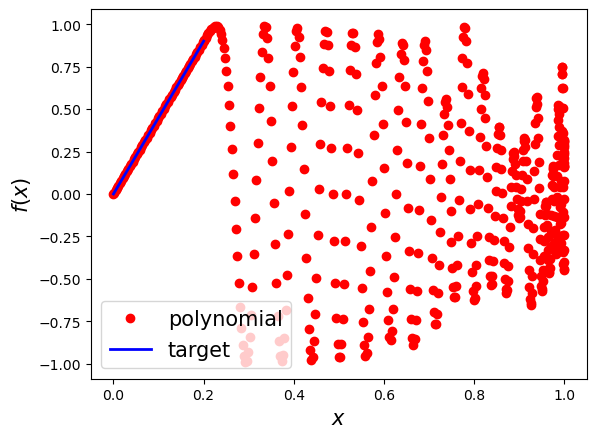
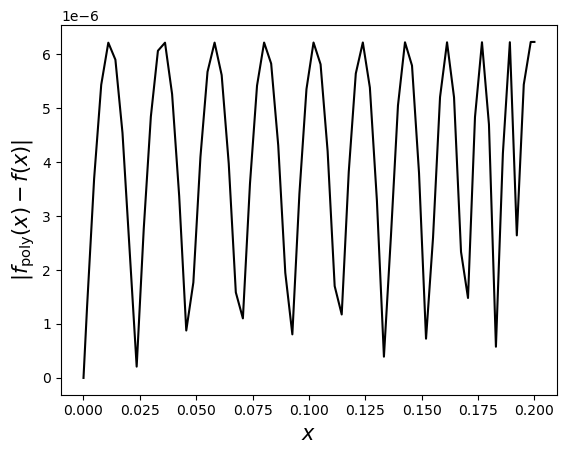
Above we see that both the \(\ell_\infty\)-error from the optimization scheme and the maximum value of the solution are outputted by cvx_poly_coef. The former verifies suitable convergence, the latter verifies that our polynomial satisfies the constraints. Additionally, since isplot=True, plots of the polynomial approximation and its error are shown.
Solving for phase factors
Now that we have a suitable polynomial approximation for our desired function, we can use the Newton method to solve for phase factors.
[4]:
opts.update({
    'maxiter': 100,
    'criteria': 1e-12,
    'useReal': True,
    'targetPre': True,
    'method': 'Newton'
})

from qsppack.solver import solve
phi_proc, out = solve(coef, parity, opts)
iter err
   1  +7.6677e-01
   2  +2.2044e-01
   3  +4.8863e-02
   4  +5.9244e-03
   5  +1.6429e-04
   6  +1.7844e-07
Stop criteria satisfied.
Verifying the solution
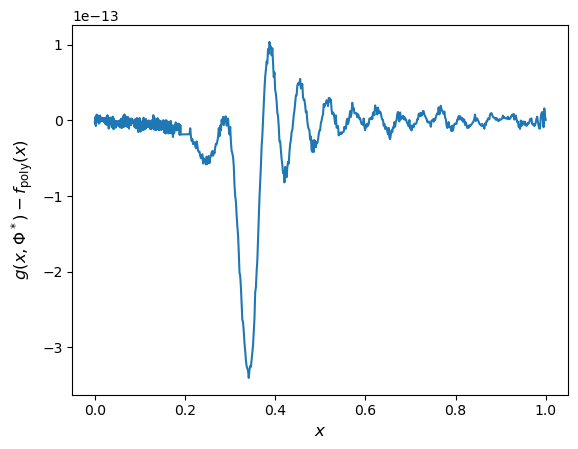
Finally, we verify the phase factors by computing and plotting the residual error.
[5]:
from qsppack.utils import chebyshev_to_func, get_entry
import matplotlib.pyplot as plt

xlist1 = np.linspace(0, a - delta, 500)
xlist2 = np.linspace(a + delta, 1, 500)
xlist = np.concatenate((xlist1, xlist2))
func = lambda x: chebyshev_to_func(x, coef, parity, True)
targ_value = targ(xlist)
func_value = func(xlist)
QSP_value = get_entry(xlist, phi_proc, out)
err = np.linalg.norm(QSP_value - func_value, np.inf)
print('The residual error is')
print(err)

plt.plot(xlist, QSP_value - func_value)
plt.xlabel('$x$', fontsize=12)
plt.ylabel('$g(x,\\Phi^*)-f_\\mathrm{poly}(x)$', fontsize=12)
plt.show()
The residual error is
3.405054016525355e-13
Reference
Gilyén, A., Su, Y., Low, G. H., & Wiebe, N. (2019, June). Quantum singular value transformation and beyond: exponential improvements for quantum matrix arithmetics. In Proceedings of the 51st Annual ACM SIGACT Symposium on Theory of Computing (pp. 193-204).
Dong, Y., Meng, X., Whaley, K. B., & Lin, L. (2021). Efficient phase-factor evaluation in quantum signal processing. Physical Review A, 103(4), 042419.