Singular Value Threshold Projector
Overview
Singular value threshold projectors project out singular vectors with singular values below or above a certain threshold. Suppose that we have access to a unitary \(U\), its inverse \(U^\dagger\) and the controlled reflection operators \((2\Pi - I)\), \((2\tilde{\Pi} - I)\). We are primarily interested in \(A := \tilde{\Pi}U\Pi\), which has a singular value decomposition \(A = W\Sigma V\). For \(S \subset R\), let \(\Sigma_S\) be the matrix obtained from \(\Sigma\) by replacing all diagonal entries \(\Sigma_{ii} \in S\) by one and all diagonal entries \(\Sigma_{ii} \notin S\) by zero. We define \(\Pi_S := \Pi V \Sigma_S V^\dagger \Pi\), and similarly \(\tilde{\Pi}_S := \tilde{\Pi}W\Sigma_S W^\dagger\tilde{\Pi}\). For example, if we let \(S=[0,\ell]\), \(\Pi_S\) projects out right singular vectors with singular value at most \(\ell\). These threshold projectors play a major role in quantum algorithms.
Polynomial approximation
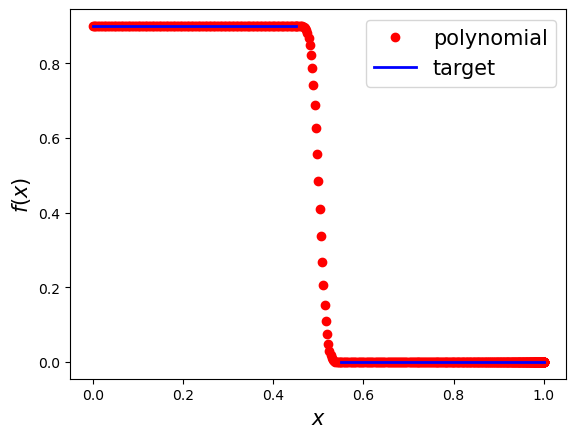
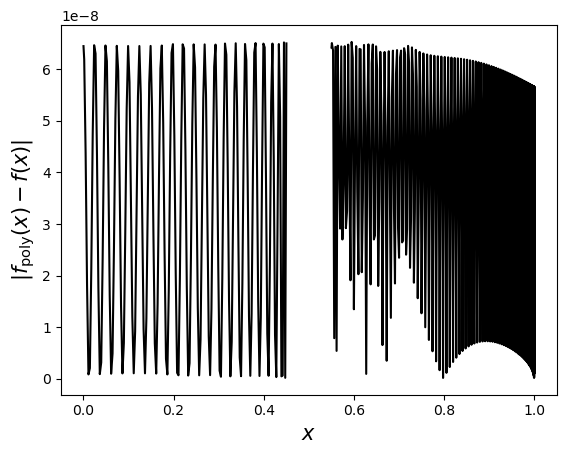
For numerical demonstration, we let \(\ell = 0.5\). To implement \(\Pi_{[0,0.5]}\), we can implement the singular value transformation of \(A\) for a rectangle function \(f\). We can call cvx_poly_coef from qsppack.utils to find the best even polynomial approximating \(f(x)\) on the interval \(D_\delta = [0, 0.5-\delta] \cup [0.5+\delta,1]\), with \(\delta = 0.05\). This subroutine uses convex optimization to solve the problem.
[1]:
import numpy as np
from qsppack.utils import cvx_poly_coef

delta = 0.05
opts = {
    'intervals': [0, 0.5-delta, 0.5+delta, 1],
    'objnorm': np.inf,
    'epsil': 0.1,
    'npts': 500,
    'fscale': 0.9,
    'maxiter': 100,
    'useReal': False,
    'targetPre': True,
    'isplot': True,
    'method': 'cvxpy'
}
targ = np.vectorize(lambda x: 1 if np.abs(x) < 0.5 else 0)
deg = 250
parity = deg % 2

coef = cvx_poly_coef(targ, deg, opts)
coef = coef[parity::2]
norm error = 6.529647593817857e-08
max of solution = 0.8999999998163493
Solve for phase factors and verify
[2]:
# Solve for phase factors
from qsppack.solver import solve
opts['method'] = 'Newton'
phi_proc, out = solve(coef, parity, opts)

# Verify result
from qsppack.utils import chebyshev_to_func, get_entry
xlist1 = np.linspace(0, 0.5 - delta, 500)
xlist2 = np.linspace(0.5 + delta, 1, 500)
xlist = np.concatenate((xlist1, xlist2))
targ_value = targ(xlist)
func_value = chebyshev_to_func(xlist, coef, parity, True)
QSP_value = get_entry(xlist, phi_proc, out)
err = np.linalg.norm(QSP_value - func_value, np.inf)
print('The residual error is')
print(err)

# Plot error
import matplotlib.pyplot as plt
plt.plot(xlist, QSP_value - func_value)
plt.xlabel('$x$', fontsize=12)
plt.ylabel('$g(x,\\Phi^*)-f_\\mathrm{poly}(x)$', fontsize=12)
plt.show()
iter err
   1  +4.8372e-01
   2  +1.9792e-01
   3  +2.7183e-02
   4  +3.0104e-04
   5  +3.2273e-08
Stop criteria satisfied.
The residual error is
1.942890293094024e-14

Reference
Gilyén, A., Su, Y., Low, G. H., & Wiebe, N. (2019, June). Quantum singular value transformation and beyond: exponential improvements for quantum matrix arithmetics. In Proceedings of the 51st Annual ACM SIGACT Symposium on Theory of Computing (pp. 193-204).
Dong, Y., Meng, X., Whaley, K. B., & Lin, L. (2021). Efficient phase-factor evaluation in quantum signal processing. Physical Review A, 103(4), 042419.